Damascus Knife Australia

Hand-picked Damascus knives for Australian kitchens · Prices in AUD · Independent Buying Guides
An Australian guide to the blade

Follow the pattern.
Know the steel.

A Damascus knife has a visible pattern in its blade, often made from layered steels or a patterned cladding around a cutting core. The pattern catches your eye. The steel, grind and edge decide how the knife works.

Independent buying guides for Australian kitchens
See the blade in motion

A closer look at Damascus knives.

Watch the video, then explore the guide to blade construction, choosing a knife and caring for its edge.

Choose your route

Find the right blade.

From a single daily workhorse to a full kitchen set, start with the job the knife needs to do.

Damascus, in plain English

What are you actually buying?

The name describes a look and a family of construction methods. It does not identify one single steel grade.

Most shoppers looking for a Damascus steel knife want two things: the rippling pattern and a good cutting tool. Those are separate questions. A listing should tell you what creates the pattern and what forms the edge. If it says only “Damascus” and gives no steel or construction details, the photo is doing more work than the specification.

01

Pattern-welded steel

Different steels are forged together and worked to produce a visible pattern. The pattern can run through the layered material, although the precise make-up varies by maker. Research on modern pattern-welded blades describes carbon diffusion between their welded layers. See the research.
02

Clad kitchen blades

Many kitchen knives sold as Damascus have a named cutting core, such as VG10, with patterned outer cladding. In that construction the core reaches the edge. The patterned sides and the cutting steel play different roles, which is why the core specification is useful when you compare knives.

03

Patterned finishes

A decorative pattern on a blade does not by itself prove layered construction. Some products are described only as having a “Damascus pattern.” Treat that phrase as a description of appearance until the maker explains the steel and process. Our real versus fake guide goes deeper.

Behind the pattern

A striking blade still has to earn its place on your board.

“67 layers” describes a construction claim, not a sharpness score. A patterned outer layer can look remarkable, while the cutting edge is defined by the core and the way it has been ground and sharpened. Modern pattern-welded steel has also been studied for the way carbon moves between welded layers. Read the metallurgy research ↗

Learn how to read a listing in our Damascus steel guide, or see how pattern-welded blades differ from a printed or etched look in our authenticity guide.

Diagram of a patterned knife blade showing outer layers and a central cutting corePATTERNED CLADDINGCUTTING CORE
  • Look beyond the layer count. Ask what steel forms the cutting edge.
  • Check the grind. A thinner, well-made blade often feels easier through food.
  • Plan for care. Wash by hand and dry promptly.
A buying guide, not a guessing game

Choose by the work, then the steel.

The right profile does more for daily cooking than a decorative layer count.

Start with one good knife

If you chop vegetables, slice boneless meat and mince herbs, a chef knife is the most flexible starting point. Around 20 cm is common, but a shorter blade can be easier to control on a small board. Check the handle length and shape against your hand. A beautiful knife you dislike gripping will stay in the drawer.

Read the listing carefully

Look for a named core steel, an explanation of the patterned layers, blade dimensions, handle material and clear care instructions. “High carbon” is too broad to identify a precise alloy. Likewise, hardness figures only help when they are credible and accompanied by a well-executed edge and heat treatment.

For a closer comparison of commonly listed steels, read VG10 vs AUS10 vs 10Cr15CoMoV. If price is the sticking point, our cost guide explains what you might pay for.

KnifeBest suited toCheck before buying
Chef knifeMost daily chopping and slicingGrip, length, weight and edge profile
SantokuVegetables and shorter, controlled cutsBlade height and room for your knuckles
NakiriVegetable prep with a straight edgeIt is not designed for bones or twisting cuts
Bread knifeCrusty loaves and soft interiorsSerration and enough length for the loaf
Knife setA kitchen that needs several distinct toolsWhether you will use each piece

Want to see how the main shapes compare? Explore chef knives, Japanese styles and knife sets.

The shortlist

Knives worth a closer look.

Browse the maker's specifications and current price at the retailer before you buy.

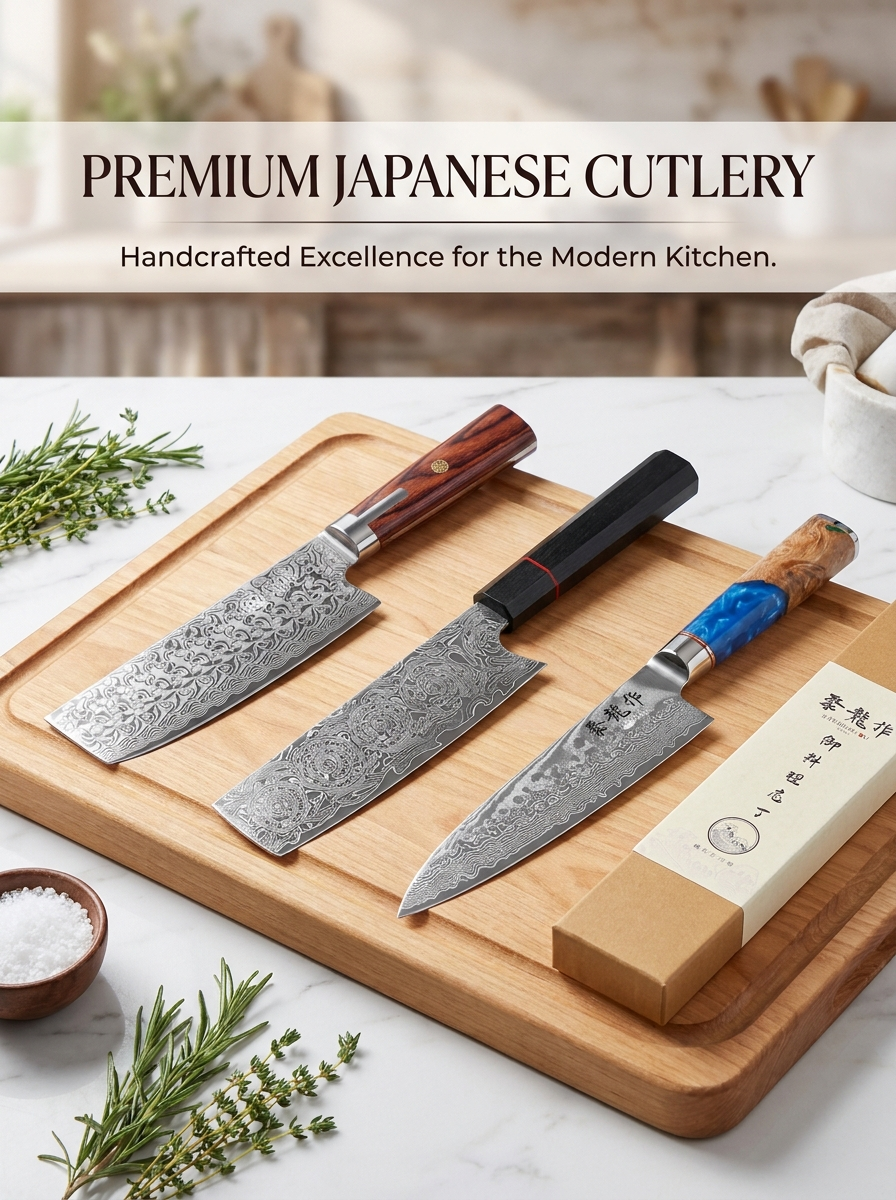
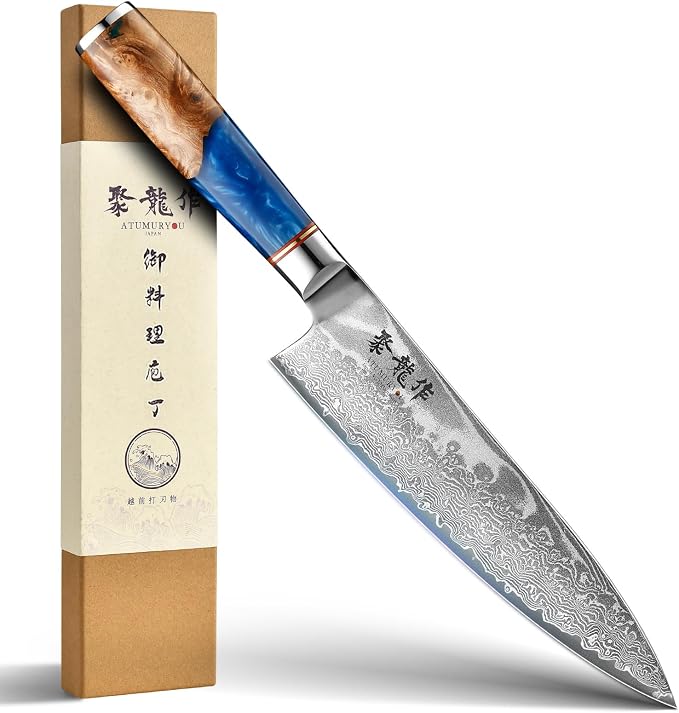
20 cm Japanese 67-layer Damascus chef knife with VG10 core
Damascus / chef knife

20 cm Japanese VG10 chef knife

A classic 20 cm profile with the listed VG10 core and layered Damascus construction.

Check on Amazon ↗
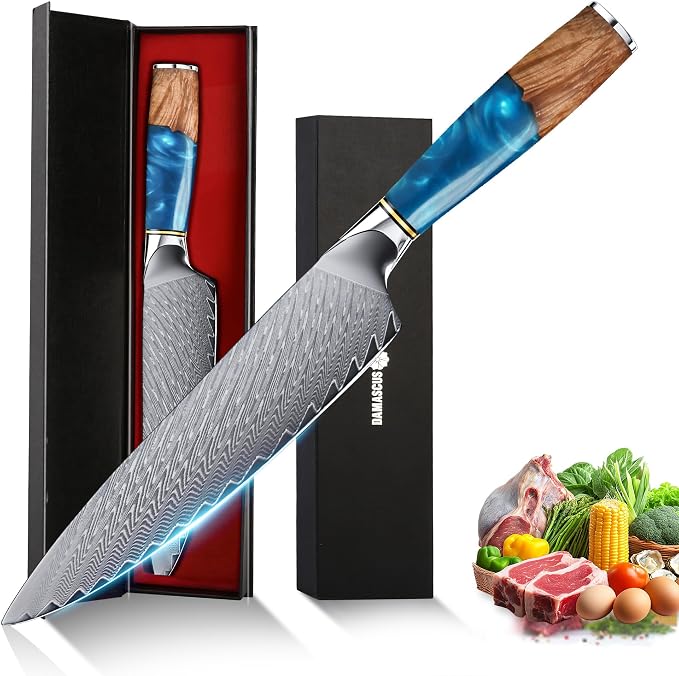
Japanese Damascus chef knife with blue resin and wood handle
Damascus / statement handle

Blue resin VG10 chef knife

A patterned blade with a blue resin and wood handle, supplied in a gift box according to its listing.

Check on Amazon ↗
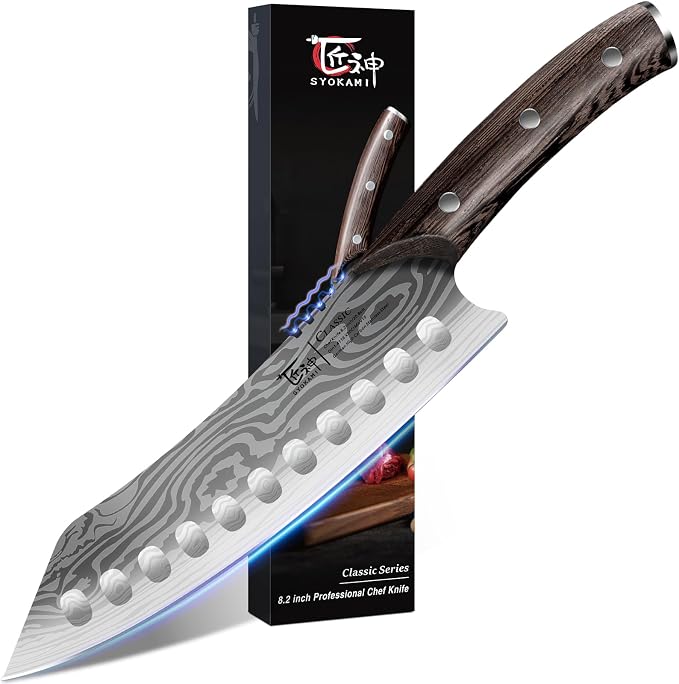
SYOKAMI Japanese chef knife with Damascus pattern
Damascus pattern / chef knife

SYOKAMI 8.2-inch chef knife

A Japanese-style kitchen knife sold with a Damascus pattern. Confirm the blade construction on the listing.

Check on Amazon ↗
Close-up of patterned Damascus steel
Damascus / VG10

MOSFiATA 8-inch chef knife

Listed as a 67-layer VG10 Damascus chef knife with a G10 handle and sharpening accessory.

Check on Amazon ↗
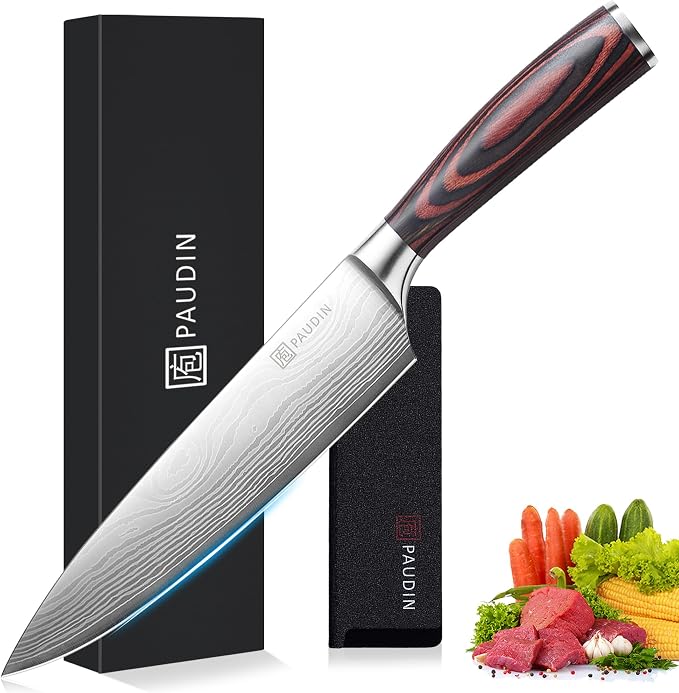
PAUDIN 8-inch high-carbon stainless steel chef knife
Alternative / stainless steel

PAUDIN 8-inch chef knife

A practical stainless steel option if you want to compare a patterned blade with a conventional chef knife.

Check on Amazon ↗
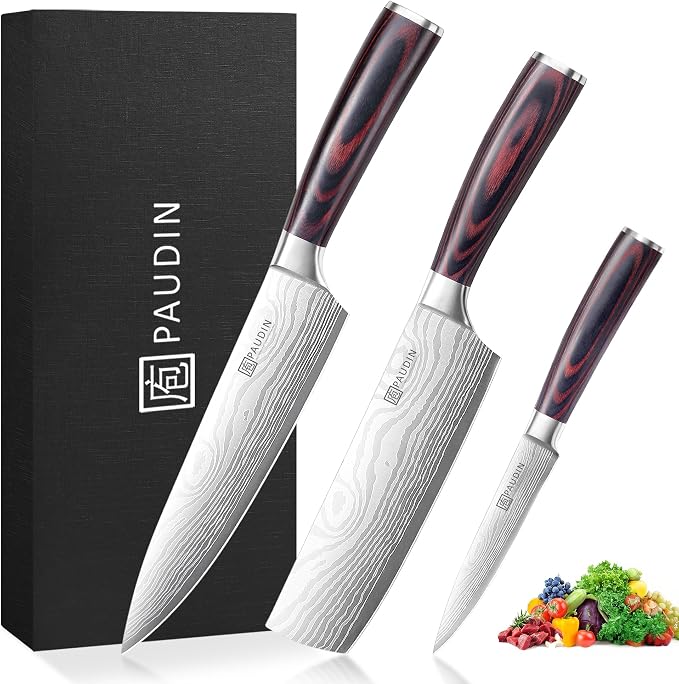
PAUDIN three-piece kitchen knife set with wood handles
Alternative / three-piece set

PAUDIN kitchen knife set

Three different kitchen knives with wooden handles. This listing does not describe them as Damascus steel.

Check on Amazon ↗
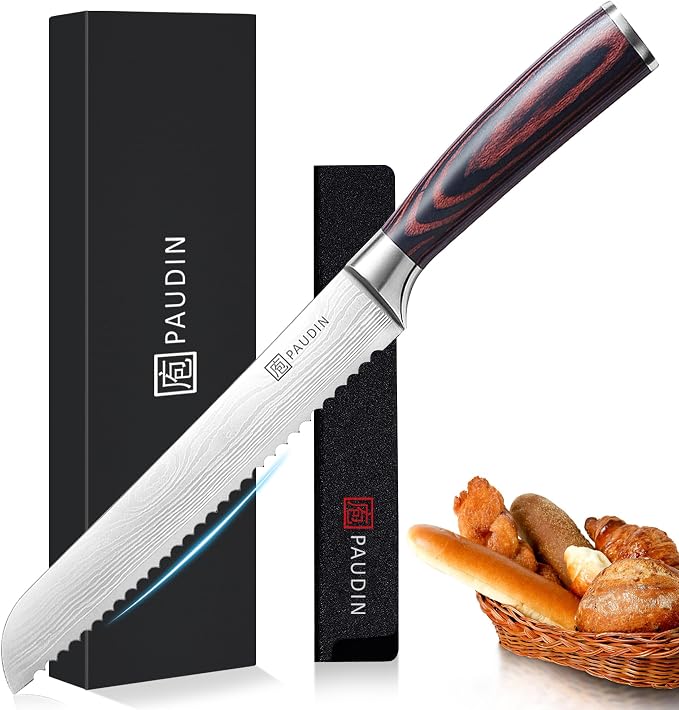
PAUDIN eight-inch serrated stainless steel bread knife
Alternative / bread knife

PAUDIN 8-inch bread knife

A serrated stainless steel knife for crusty loaves. Included as a useful kitchen companion, not a Damascus blade.

Check on Amazon ↗

As an Amazon Associate, we earn from qualifying purchases. Some picks above are stainless steel alternatives, clearly labelled. Availability, prices and specifications may change at the retailer. See our affiliate disclosure.

After the unboxing

How to keep your knife working.

A good routine is simple. The precise care requirements can differ by steel and handle, so keep the maker's instructions.

01

Use a board

Cut on wood or a suitable plastic board. Glass, stone and ceramic surfaces are hard on fine edges.

02

Wash by hand

Clean the blade with mild soap and water. Avoid leaving it soaking in the sink, especially if the steel or handle is reactive.

03

Dry it promptly

Wipe the blade and handle dry after washing. Water left around the edge, tang or handle can create avoidable problems.

04

Protect the edge

Store it in a sheath, block or on a suitable rack. When it stops cutting cleanly, use an appropriate sharpening method.

A patterned blade still needs ordinary knife care. Our cleaning guide covers stains and rust, while the sharpening guide explains edge upkeep. Avoid grinding away a patterned finish without understanding the blade's construction.

How we approach these picks: This page uses the product names, images and specifications supplied for the listed items. It separates knives described as Damascus from stainless steel alternatives. We have not claimed hands-on testing or invented scores. Product details and stock should be confirmed at the retailer. For the steel discussion, see the pattern-welded blade research. For imports, consult the Australian Border Force.
Quick answers

Good questions make better buys.

If you are ordering a knife from overseas, check the current Australian Border Force guidance and the rules where you live. Knife type and design matter for import controls.

Is every patterned knife real Damascus?

No. A visible pattern alone cannot tell you whether the blade is pattern-welded, clad around a core, or given a surface finish. Read the manufacturer's construction details and our real versus fake guide.

Does a higher layer count make a knife sharper?

No. Sharpness depends on the cutting edge and its geometry. Layer count tells you little about how a knife will feel during prep.

What is the best first Damascus kitchen knife?

For most home cooks, start with a comfortable chef knife around 20 cm. Check its core steel, blade weight, handle and maintenance needs. Browse the chef knife guide.

Can a Damascus knife go in the dishwasher?

Hand washing is the safer habit. Wash the blade after use, dry it thoroughly and store it so the edge does not knock against other utensils. Read the full care guide.